At 11,500 feet,,
the world quietens.
Ladakh is not a landscape you pass through — it is one you adjust to. The altitude demands a slower pace and rewards it entirely: roads that cross passes at 5,350 metres, a sky so clean that the stars appear close enough to resolve into colour.
The roof of India,
open to those who arrive prepared.
Ladakh is a high-altitude cold desert in the northernmost reaches of India, bordered by Pakistan to the west, China to the east, and the Great Himalayan and Karakoram ranges above. Its culture is Tibetan Buddhist in origin — a thread of continuity that stretches from the ninth-century Alchi monastery to the living Gelugpa monasteries of Thiksey, Hemis, and Diskit that still house active monastic communities. The landscape is starkly beautiful: bare brown mountains streaked with mineral colour, river valleys of glacial green, and the jewel-blue of Pangong Tso at 4,350 metres.
Travalive's Ladakh programmes are built around acclimatisation, timing, and local knowledge. The altitude is real and requires respect — we design itineraries that allow the body to adjust properly rather than rushing clients to high passes on day two. Our ground team in Leh maintains relationships with the forest department, the monastery authorities, and the Ladakhi operators whose vehicles and drivers actually know the roads.

What you come here for.
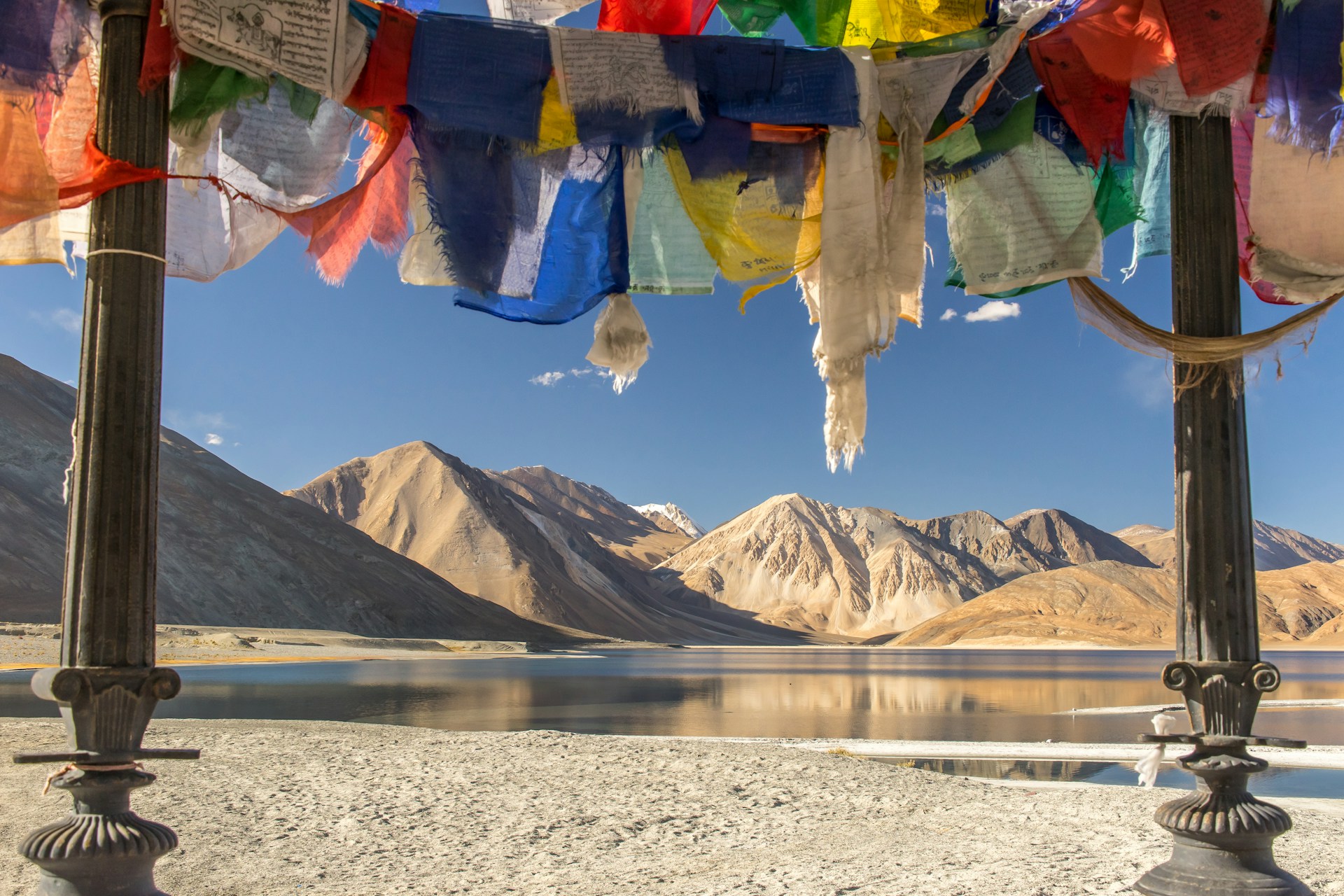
Pangong Tso sits at 4,350 metres, stretching 134km from India into Tibet. The colour — an impossible gradient from aquamarine to deep cobalt — changes with the light and the wind. A night at the lake, in a properly insulated camp rather than a tourist tent cluster, is the definitive Ladakh experience: sub- zero nights, complete silence, and a dawn that turns the surrounding mountains pink before the lake itself warms.
The Nubra Valley north of the Khardung La pass (5,350m) is a wide, warm desert valley that was part of the ancient Silk Route. The sand dunes at Hunder host a population of Bactrian double-humped camels — relics of the caravan trade — that coexist incongruously with the Himalayan backdrop. The drive over Khardung La itself, one of the highest motorable roads in the world, is the attraction.
Thiksey, Hemis, Lamayuru, Alchi, Diskit — Ladakh's monastery circuit spans twelve centuries of Tibetan Buddhist architecture. Thiksey, rising above the Indus valley in a stack of white-washed tiers, is the most photogenic. Hemis hosts the largest festival in Ladakh each June-July. Alchi holds the oldest surviving murals — ninth-century Kashmiri Buddhist art found nowhere else. We arrange early access and an interpreter fluent in both Tibetan iconography and English.
The Markha Valley, Chadar (frozen river), Sham Valley, and the Stok Kangri summit are among Ladakh's established trek routes. Markha Valley (five to seven days) is the classic — high passes, village homestays, and the long view into the Zanskar range. Travalive arranges permits, guides, horses for equipment, and camping with a crew trained specifically for high-altitude conditions.
Zanskar is cut off from the rest of India for six to eight months each year when the snow closes its only road. In winter, the frozen Zanskar River becomes the Chadar Trek — a multi-day walk on ice through a canyon that effectively has no other access. In summer, the overland route from Kargil opens through some of the most extreme landscape in the Indian Himalaya. Travalive manages the full logistics for both seasonal variations.
The villages between Leh and Hemis — Shey, Thiksey, Stakna — sit in the Indus floodplain at 3,500 metres, surrounded by barley fields and apricot orchards. A morning walk through a working village with a Ladakhi guide reveals a life of particular organisation and beauty: the water channels, the flat-roofed houses stacked with drying firewood, the household chortens. It is a counterpoint to the landscape scale.
The experiences that define the journey.

A Night at Pangong Tso
The standard Pangong visit is a day-trip: arrive, photograph, drive back. We arrange one or two nights at a small, properly insulated camp set apart from the main cluster on the south shore — twelve tents, a heated dining tent, and a crew that includes a cook who knows what the altitude does to sleeping bodies and adjusts the food accordingly. The second morning is the reason to stay: the light on the water at 6am, with the temperature still below zero and the western mountains in shadow while the Tibetan plateau beyond the lake catches the first direct sun. No organised activity. No schedule. Just the lake.
Hemis Monastery — Off Festival Season
The Hemis Festival draws thousands of visitors in June and July. The monastery itself, away from festival season, is equally worth an extended visit. Hemis is the wealthiest monastery in Ladakh — its museum holds thangkas, sacred masks, and silverwork of extraordinary quality, and its library contains texts that have never been translated. We arrange access with the monastery's liaison monk, who provides context that the standard audio guide cannot. The visit takes three hours done properly; the standard tourist version takes forty minutes.

Markha Valley Trek
The Markha Valley trek (five to seven days) is Ladakh's most rewarding standard route — not because it is the most dramatic, but because it passes through inhabited Ladakhi villages where the trail is still used by locals and the landscape changes from Indus valley scrub to high alpine pass to remote valley in a logical progression that rewards each day's effort. We use a crew of four for a group of two: a lead guide, a cook, and two horsemen who move equipment between camps. Permits, park fees, and all camping equipment arranged. Acclimatisation days in Leh are mandatory and built into the pre-trek itinerary.
10 days in
Ladakh.
This ten-day itinerary allows two full acclimatisation days in Leh before moving to the high-altitude excursions — a structure that is not optional at 3,500 metres but is routinely ignored by operators trying to compress duration. The Pangong and Nubra circuits require permits arranged in advance; Travalive handles all of this. The trek option can replace days five through eight for those who want it.
Arrival at Kushok Bakula Rimpochee Airport, Leh. Transfer to hotel — a heritage Ladakhi guesthouse in the old quarter or a newer property with mountain views, depending on your preference. The first day is for rest only: no sightseeing, no exertion, 3–4 litres of water, and an early night. The altitude will make itself known regardless of fitness level.
Light dinner at the hotel. Briefing from Travalive's Leh-based coordinator on the programme, road conditions, and what to expect over the following days.
A gentle half-day in Leh old town — the bazaar, the Jama Masjid, and the nine-storey Leh Palace (abandoned in the nineteenth century, structurally intact) above the market. The walk from the bazaar to the palace is the right altitude of exertion for day two. Afternoon at rest. Shanti Stupa at sunset if energy permits — the view of the Indus valley from the stupa platform is the definitive Leh orientation.
A full day in the Indus valley monasteries east of Leh. Thiksey first — the morning puja at 6am if the timing works, the main shrine room and its 15-metre Maitreya Buddha, and the rooftop with the valley spread below. Then Hemis — the richest monastery in Ladakh — with extended access to the museum collection. Return via Shey Palace and the barley fields of the Indus floodplain.
The drive north over Khardung La (5,359m) takes approximately 2.5 hours to the pass. The road is one of the highest motorable roads in the world — at the summit the oxygen content is roughly 50% of sea level. Descent into the warm Nubra Valley, check-in at a valley camp, and afternoon visit to Diskit Monastery and the giant Maitreya Buddha overlooking the Shyok River. Camel ride on the Hunder dunes at dusk.
A day in the quieter Nubra — north to Panamik, the last village before the military zone, and the natural hot springs above the village. The Samstanling monastery at Sumur is rarely visited and holds some of the better-preserved religious art in the valley. Return south to the Hunder camp for the night.
The road from Nubra to Pangong via Agham and Shyok (approx. 5–6 hours) is one of the most dramatic drives in Ladakh — a narrow track above the Shyok River with views into Pakistan. Arrival at Pangong in the early afternoon gives time to settle and walk the lakeshore before the light changes. Night at the lake camp.
Dawn at the lake: the hour when the temperature is still below zero and the water's colour is at its most intense. Breakfast at the camp, then drive back to Leh via Chang La (5,360m) — a different pass with a different landscape quality than Khardung. Afternoon arrival in Leh.
A recovery day from the altitude and the drives. Morning at leisure in Leh. Afternoon drive west along the Indus to Alchi (67km) — the oldest monastery in Ladakh, housing ninth-century Kashmiri Buddhist murals of extraordinary quality that have no parallel elsewhere in India. The monastery is small, the paintings are intimate, and the visit rewards a slow pace and a good guide.
A full day at leisure in Leh. The morning market in the old town sells Ladakhi wool, thangka paintings, turquoise jewellery, and the dried apricots that Nubra Valley is known for. The Ecology Centre's handicraft shop offers fairly priced pashmina and Ladakhi craft with direct artisan relationships. Final briefing with the Travalive coordinator and packing for departure.
Private transfer to the airport. The Leh–Delhi flight is 1 hour 20 minutes. Departure slots from Leh are typically early morning due to mountain wind conditions that close the airport by mid-morning. Travalive manages the transfer and confirms all departure logistics the evening before.
Ladakh, on your terms.
Tell us what you are thinking — a timeframe, a mood, a question — and one of our consultants will come back to you with something worth reading. No automated quotes. No fixed packages. A real conversation.